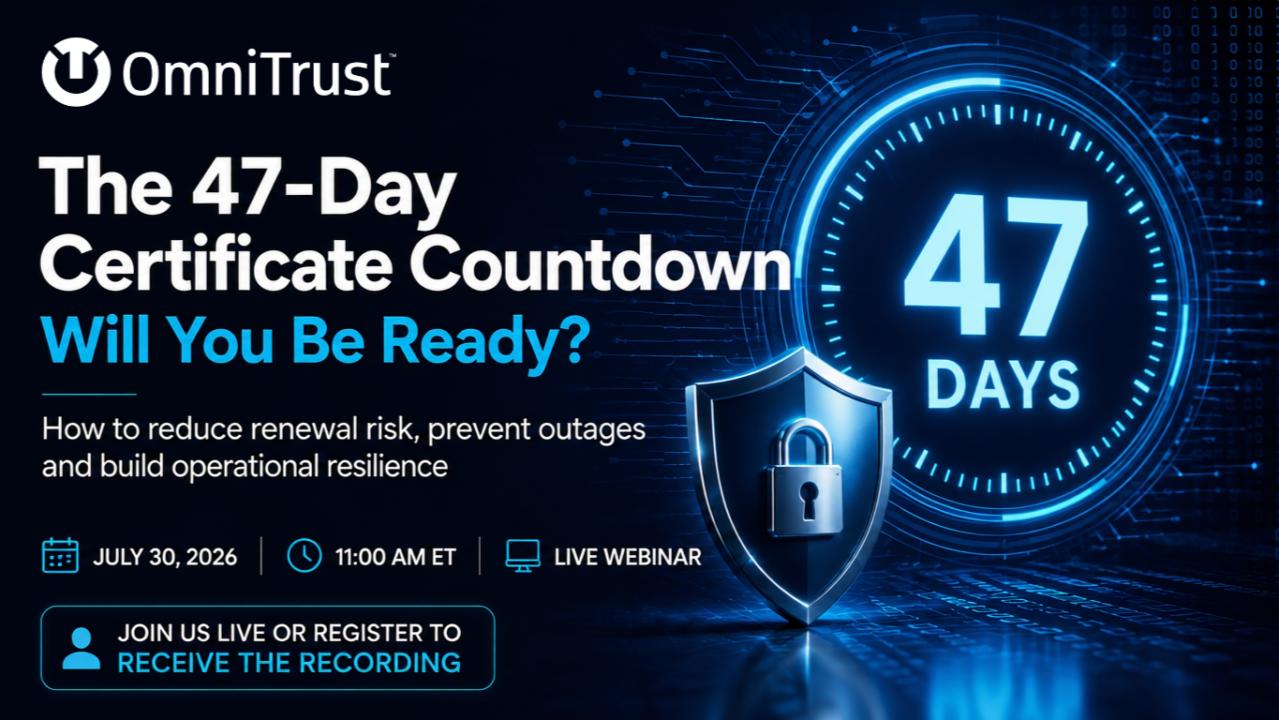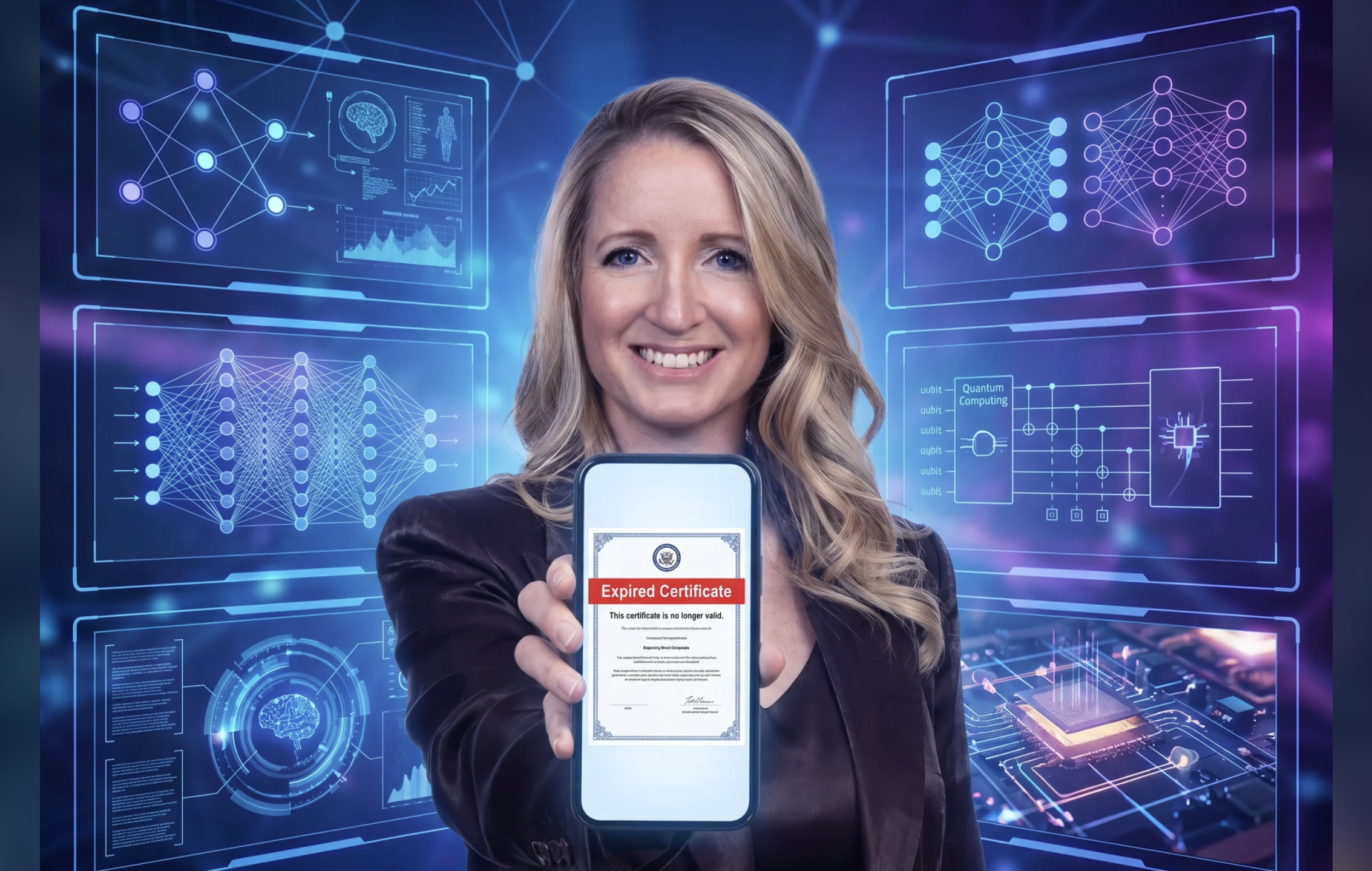
It’s 2026. We’re talking about AI agents, autonomous systems, quantum computing, and a future that seems to be accelerating toward AGI every day. 🚀.
And yet…Organizations are still suffering outages because a security certificate expired. Seriously.

It’s one of those strange technology realities that feels almost impossible to explain to someone outside cybersecurity. Right up there with the fact that fax machines still exist 📠, dial-up connections are somehow still operational, and barcodes remain one of the most important technologies on the planet .
As absurd as it sounds, expired certificates continue to disrupt applications, websites, APIs, cloud services, manufacturing systems, and critical infrastructure around the world.
Recently, OmniTrust’s own Sam Delsing tackled this topic in an episode of Open Secrets her growing cybersecurity channel where she breaks down the issues security leaders actually deal with every day. One of the most interesting takeaways is that certificate expirations are rarely caused by incompeten
ce or negligence. More often, they’re caused by complexity.
The Real Problem Isn’t Certificates
Most organizations don’t have a certificate problem. They have a visibility problem.
Over the years, cryptographic assets become scattered across cloud platforms, Kubernetes environments, APIs, applications, load balancers, code-signing systems, secrets vaults, IoT devices, DevOps pipelines, and multiple certificate authorities. Different teams own different pieces. Different tools manage different environments. Different processes govern different systems. Eventually nobody has a complete picture. The outage isn’t caused because someone forgot. The outage happens because nobody knew the asset existed in the first place.
Crypto Sprawl Is Real
As organizations modernized, they accumulated layers of trust infrastructure.
A Microsoft CA over here. A public certificate provider over there. A cloud-native PKI service somewhere else. A secrets manager owned by DevOps. A code-signing platform managed by engineering. An HSM managed by security.
Individually, each system may work perfectly. Collectively, they create fragmentation- And fragmentation is where outages live.
The Challenge Is Growing, Not Shrinking
Machine identities now vastly outnumber human identities.
Every workload, API, service, container, device, application, and increasingly every AI-driven system requires identity, authentication, certificates, keys, secrets, and cryptographic trust. At the same time:
- Certificate lifetimes are shrinking
- Compliance requirements are increasing
- Machine identities are exploding
- AI introduces new non-human identities
- Post-quantum migration is approaching
Managing all of this manually simply doesn’t scale.
Compliance Is Raising the Stakes
Regulations such as the EU Cyber Resilience Act (CRA), NIS2, DORA, and evolving NIST guidance are forcing organizations to prove they understand and control their cryptographic assets throughout the lifecycle. Auditors increasingly want answers to questions like:
- What certificates exist?
- Where are they deployed?
- Who owns them?
- When do they expire?
- What systems depend on them?
- How will they transition to post-quantum cryptography?
Those aren’t spreadsheet questions anymore. They’re lifecycle governance questions.
Then Comes Post-Quantum Cryptography
Many organizations are already discussing post-quantum readiness.
But here’s the catch: You can’t modernize cryptography if you don’t know where it lives. Post-quantum migration isn’t just about replacing algorithms. It’s about understanding certificates, keys, secrets, dependencies, ownership, automation, and lifecycle governance across thousands – or millions of cryptographic assets. In other words, the same fragmentation causing certificate outages today becomes an even bigger problem tomorrow.
The Future Isn’t Certificate Management
The future is trust lifecycle management. Organizations need visibility, automation, governance, and lifecycle control across:
🔹 Certificates
🔹 Keys
🔹 Secrets
🔹 Tokens
🔹 Digital Signatures
🔹 Machine Identities
🔹 AI Identities
Trust isn’t a point security problem anymore.
And that’s exactly why platforms like OmniTrust ILM exist – to unify fragmented cryptographic environments, automate lifecycle operations, reduce outages, support compliance initiatives, and prepare organizations for a future where trust must extend from silicon to cloud to AI.
The Irony of 2026
 Maybe the biggest lesson is this: While the industry spends endless time talking about AI, autonomous agents, and the future of computing, many organizations are still wrestling with one of cybersecurity’s oldest operational problems. An expired certificate. The issue was never really the certificate. The issue is everything surrounding it. And that’s where modernization begins.
—————————————————————————————
If you enjoy dry humor, a smart mom, practical cybersecurity insights, and the occasional uncomfortable truth about how technology actually works, give Sam a follow:
📺 YouTube: https://lnkd.in/gVa5hsJz
📸 Instagram: https://lnkd.in/gS9r8vMq
💼 LinkedIn: https://lnkd.in/g7tMqv-N
🎵 TikTok: https://lnkd.in/grNTkNDA
🌐 OmniTrust: www.OmniTrust.com
#CyberSecurity #PKI #Certificates #DigitalTrust #MachineIdentity #PostQuantumCryptography #PQC #EUCRA #NIS2 #CyberResilienceAct #IdentityManagement #Cryptography #OpenSecrets #SamDelsing #OmniTrust #TrustLifecycleManagement #ILM