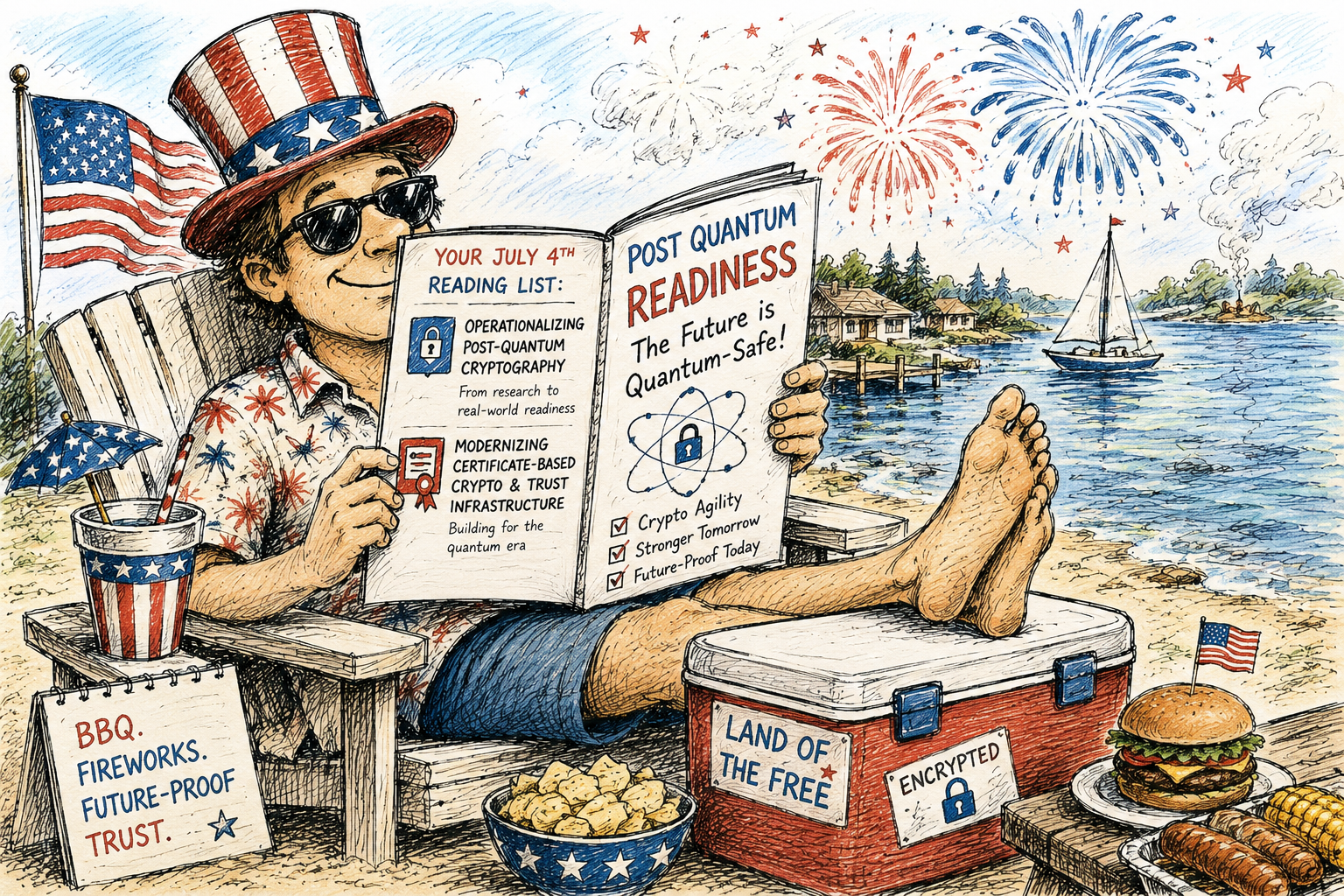
The glizzys are on the grill. The fireworks are ready. Long weekends are meant for relaxing, but if you’re one of those people who actually enjoys cybersecurity beach reading (you know who you are), this Fourth of July comes with something else worth celebrating.
On June 22nd, Washington sent one of the clearest signals yet that post-quantum cryptography has officially moved beyond research and into national policy. Executive Orders issued in late June don’t simply acknowledge the quantum threat—they establish timelines, accountability, and expectations that will influence not only federal agencies, but contractors, critical infrastructure, and eventually the broader enterprise.
The conversation has changed.
For years, the industry has focused on why quantum computing matters. There are countless articles explaining the mathematics, the algorithms, and the looming risks. What’s been missing is practical guidance on what organizations should actually do next. That’s why we’re excited to publish two new strategic white papers designed to help security leaders move from awareness to action.
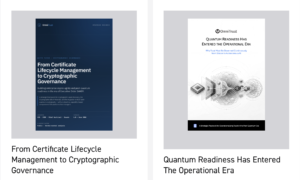
📘 From Certificate Lifecycle Management to Cryptographic Governance
Why the future isn’t about managing certificates – it’s about governing cryptography.
For nearly three decades, enterprise trust has evolved in predictable stages.
First came PKI. Then Certificate Lifecycle Management (CLM). Then Machine Identity Management.
But post-quantum cryptography, shrinking certificate lifetimes, cloud-native infrastructure, AI, and software supply chains are exposing an uncomfortable truth:
The certificate was never the thing that mattered. It was simply the most visible representation of something much larger.
Today’s challenge isn’t renewing certificates. It’s understanding—and governing—the entire cryptographic estate.
Keys, Secrets, Algorithms. Hardware Security Modules, Machine identities, Embedded cryptography, Software signing, Cloud workloads, AI identities.
This white paper explores why the industry is entering the next phase of trust management: Cryptographic Governance. Drawing on the latest federal guidance, including Executive Order 14409, it introduces a practical framework for moving beyond certificate-centric thinking toward enterprise-wide cryptographic visibility, governance, and crypto-agility.
Inside you’ll discover:
- Why Executive Order 14409 changes the conversation from certificate management to cryptographic inventory.
- The Cryptographic Governance Maturity Model (CGMM) for assessing your organization’s readiness.
- Why the Cryptographic Bill of Materials (CBOM) may become one of the most important operational artifacts of the next decade.
- A capability-based comparison of today’s leading cryptographic lifecycle and governance platforms.
- Practical recommendations for government, financial services, manufacturing, healthcare, cloud-native organizations, and critical infrastructure.
If your organization is asking, “Where is our cryptography, who owns it, and how quickly can we change it?” this paper is for you.
📗 Quantum Readiness Has Entered the Operational Era
Why post-quantum readiness is becoming an operational discipline – not just a cryptographic project.
Replacing algorithms is only the beginning. The real challenge is something much larger. Modern organizations now depend on cryptographic trust across nearly every operational layer:
- Silicon and hardware roots of trust
- Manufacturing and secure provisioning
- Connected devices and IoT
- Software supply chains
- PKI and machine identities
- Cloud infrastructure
- APIs and workload identity
- Operational technology
- AI systems and autonomous agents
Every one of these systems depends on cryptography. Every one has its own lifecycle. And every one must remain trustworthy as algorithms, regulations, software, and threats continue to evolve.
This white paper argues that quantum computing didn’t create a trust crisis—it exposed one that already existed. Fragmented trust architectures, disconnected lifecycle processes, and siloed ownership models are rapidly becoming operational liabilities. Rather than treating post-quantum cryptography as another migration project, this paper presents a broader operational framework for governing trust continuously across the entire digital ecosystem.
Inside you’ll find:
- The Quantum Operational Readiness Index (QORI) to help benchmark your organization’s maturity.
- Practical guidance tailored to semiconductor manufacturers, device makers, software organizations, cloud teams, and AI leaders.
- Recommendations for operationalizing trust across software signing, device identity, firmware, cloud infrastructure, AI agents, and autonomous systems.
- A roadmap for building an Operational Trust Center of Excellence that unifies cryptographic governance, software integrity, lifecycle visibility, and runtime enforcement.
The central message is simple: The organizations that succeed in the post-quantum era won’t simply migrate algorithms faster. They’ll operationalize trust more effectively.
Beyond Quantum Hype
It’s easy to think of post-quantum cryptography as a future problem. It’s harder—but far more valuable—to recognize it as an opportunity to modernize how trust is governed across the enterprise. Whether you’re responsible for enterprise PKI, cryptographic modernization, product security, software supply chains, connected devices, or AI governance, the questions are becoming the same:
- What cryptographic assets do we actually have?
- Where are our biggest risks?
- How quickly can we adapt?
- Who owns operational trust?
Those aren’t research questions anymore. They’re operational questions.
Happy Fourth of July!
If you’re looking for a little cybersecurity reading between the cookouts, parades, and fireworks, we hope these papers provide useful perspectives—and perhaps a few new ways of thinking about the road ahead.
The future won’t belong to the organizations that simply become post-quantum compliant. It will belong to those that become operationally trust-ready.
Happy Independence Day 🇺🇸 ….. from Team OmniTrust!
P.S. If your July 4th beach reading includes lattice cryptography, certificate hierarchies, and cryptographic agility… you’ve definitely found your people.
P.P.S. The only thing that should expire this weekend is the potato salad – not your certificates.